


Material Recycling Association of India (MRAI)


Established in 2011 as the Metal Recycling Association of India and rechristened in 2018 as the Material Recycling Association of India (MRAI) under the guidance of NITI Aayog, MRAI is the apex national association representing India’s material recycling and resource recovery industry. MRAI serves as a key industry interface with the Government of India on matters relating to circular economy, resource efficiency, recycling policy, sustainable manufacturing and climate action.
With over 2,000 members, including leading regional trade and product associations, MRAI represents a diverse recycling ecosystem comprising more than 25,000 MSMEs and SMEs, generating over 25 lakh direct and indirect employment opportunities, with women accounting for over 40% of the workforce. Its members operate across a wide range of recyclable commodities, including ferrous and non-ferrous metals, plastics, paper, e-waste, tyres and rubber, used oil, solar waste, batteries and end-of-life vehicles (ELVs).
MRAI works closely with concerned Central and State Government Ministries, NITI Aayog, regulatory authorities, international organisations and industry stakeholders to strengthen India’s recycling ecosystem. Over the years, the Association has actively contributed to policy formulation, stakeholder consultations and industry engagement in areas such as recycling, circular economy, resource efficiency and sustainable materials management.

IMRC – Background and Global Platform
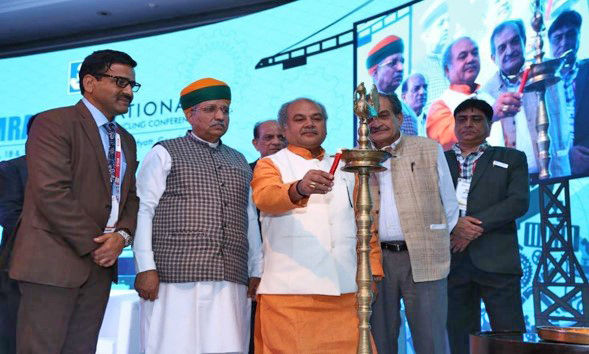
Over the past 13 years, the International Material Recycling Conference & Exposition (IMRC) has evolved into a premier international platform for policy dialogue, business engagement, knowledge exchange and collaboration across the global material recycling and circular economy ecosystem.
The 14th International Material Recycling Conference & Exposition (IMRC 2027) will be held from 18–20 January 2027 at the Novotel Jaipur Convention Centre, Jaipur, India. The event is expected to bring together 3,500+ delegates from 50+ countries, 230+ exhibitors, 50+ national and international associations, and 25+ media houses, creating a comprehensive platform for policymakers, industry leaders, recyclers, technology providers, manufacturers, investors, researchers, and other stakeholders.
What to Expect at IMRC 2027:
1. Sectoral Brainstorming and Policy Dialogues: IMRC 2027 will feature sector-specific brainstorming sessions, policy dialogues and knowledge-driven discussions across Ferrous & Non-Ferrous Metals, E-Waste, Batteries & Li-ion Recycling, Critical Minerals & Rare Earths, Tyres & Rubber, Pyrolysis, ELVs, Plastics, Textiles, C&D Waste, Used Oil, and Solar Waste. These sessions will bring together policymakers, industry leaders, recyclers, technology providers, manufacturers, researchers and investors to address policy and regulatory priorities, supply-chain challenges, technological innovation, resource security and pathways for sustainable industry growth.
Advancing Circularity, Resource Efficiency and Climate Action
2. As India experiences rapid urbanisation, industrialisation and increasing material consumption, recycling is becoming increasingly Important for resource security, sustainable development and low-carbon growth.
IMRC 2027 will focus on circular economy and resource efficiency, waste-to-wealth, industrial decarbonisation, carbon mechanisms, sustainable supply chains, secondary raw-material security, research and development, and advanced material recovery. By recovering valuable materials from end-of-life products and diverse waste streams, the recycling industry can conserve natural resources, improve material efficiency, reduce waste and material losses, strengthen the availability of secondary raw materials and contribute to lower-carbon industrial value chains.
Through IMRC 2027, MRAI aims to bring the global recycling community together to exchange knowledge, build partnerships, showcase technologies and collectively advance the recycling ecosystem towards greater circularity, resource security, sustainability and global competitiveness.


Comments